


I just returned from BRANDWEEK, a gathering of senior marketers from across the US hosted by ADWEEK.
Here’s my biggest takeaways from Brandweek 2026.
Mattel is reinventing themselves as a franchise manager rather than a toy company. The CMO doesn’t like the term consumers, and considers them fans or fandoms instead. A trend consistent with major entertainment companies moving from supporting releases and instead of supporting IP ecosystems.
Funnels are out. Consumer flywheels are in. Consumer journeys move people from products to movies to TV to digital gaming by creating a flywheel where people interact with the brands at multiple touchpoints. These cyclical journeys are gaining new priorities amongst senior marketers to conceptualize how they deploy marketing rather than the funnel which maps awareness to a single purchase.
CNN is launching new direct to consumer products (again). The most interesting concept was the examination of a post vs an anchor. Hosts introduce people to others for information or entertainment while anchors literally anchor a show around a focal point to bring you back to the same point over and over.
Scent branding seems to be on the rise. A scent can accompany products or experiences to build additional resonance.OSMOs has created several scents with major brands. They usually accompany packaging or instore experiences. I doubt its efficacy amongst service base companies without a tangible product you can touch… or smell.
MCPs, know as model content protocol, servers is a lightweight program that connects various models and agents together to external data sources, tools and services. For example the video generator, Higgsfield.AI, is essentially a MCP server (model context protocol) that draws different video models together to generate video outputs based on inputs. Instead of building one-off API connectors for every single AI model, they build one MCP server that any compliant AI can automatically discover and use.
Higher education are big brands. A&M college claims one of the biggest fandoms in the world. 80,000 students attend the school each year. 80% of college grades buy the ring. 4/5 aggies live in Texas. These brands are now sponsoring major events like the indie 500, and winning it.
Lots of follow-ups with senior marketers we met on the ground. We’re surely back in full swing as the Summer comes to a close.
3 Stories Shaping Media, Gaming and Tech
Netflix, Amazon, and YouTube announced on September 9th the formation of a new Washington D.C. lobbying group called the Streaming Access and Choice Alliance (SACA), organized under the tech trade association TechNet, aiming to protect streaming services’ right to sign exclusive sports broadcasting deals amid mounting congressional pressure over pricing and fragmentation. The alliance arrives as lawmakers turn up scrutiny on the industry’s marquee sports deals, including YouTube’s seven-year NFL Sunday Ticket agreement, Netflix’s $5 billion, 10-year WWE Raw deal, and Amazon’s 11-year NBA rights agreement, with Senator Tammy Baldwin pushing legislation that would require free, consolidated access to local games after citing Wisconsin fans paying over $1,500 a year across fragmented services just to watch the Packers, Brewers, and Bucks. The House Judiciary Committee has separately called the Sports Broadcasting Act of 1961’s antitrust exemption “gone awry,” and notably absent from SACA’s founding roster is Disney, despite ESPN+ and Disney+ being major streaming-sports players in their own right.
Why it matters: For brands and agencies, this is a signal that sports-streaming economics are entering a genuinely contested phase, not just a pricing story but a policy one that could reshape how exclusivity, bundling, and consumer access work for premium live content. If Congress moves toward mandating consolidated or free access to local sports, the exclusivity that Netflix, Amazon, and YouTube have paid billions to lock down becomes less durable, and the value proposition advertisers are buying into on those platforms shifts with it. Disney’s absence from the coalition is worth watching too, since it suggests either a hedge toward legacy-studio lobbying channels over tech-platform ones, or a bet that its Disney+/ESPN/Hulu bundle isn’t as exposed to the same pressure. Either way, anyone building 2027 sports-streaming media plans should treat regulatory risk as a live variable, not a footnote.
Saudi Arabia’s Public Investment Fund is weighing a merger of Electronic Arts with Savvy Games Group to create what would become one of the largest gaming companies in the world, Bloomberg reported September 10th, a combination that would fold EA’s Battlefield, Madden NFL, The Sims, and Pokémon GO franchises alongside Savvy’s growing portfolio under one corporate structure. PIF completed its $55 billion take-private acquisition of EA just last month, and Savvy, backed by $38 billion from PIF, has separately built out its own gaming empire through a $4.9 billion acquisition of Scopely, roughly $3.5 billion for Niantic’s games business, and a pending $6 billion deal for Chinese mobile publisher Moonton Games, meaning merger talks are unlikely to advance until the Moonton deal closes. The deliberations follow the September 1st departure of Savvy Games Group CEO Brian Ward, and the stated rationale is improving coordination across PIF’s sprawling gaming investments now that Savvy has effectively become PIF’s preferred vehicle for gaming M&A.
Why it matters: If this merger happens, it consolidates an enormous share of the world’s most-played franchises, EA’s sports and life-sim titles, Scopely’s mobile hits like Monopoly GO! Niantic’s AR titles like Pokémon GO, and whatever Moonton brings, under a single Saudi-backed holding structure, which meaningfully shifts who brands and agencies are actually negotiating with for in-game advertising, licensing, and brand-partnership deals across gaming. It also raises the antitrust profile of PIF’s gaming strategy considerably; regulators are already primed to scrutinize major gaming transactions, and a combination of this scale invites exactly that kind of review. For marketers who lean on gaming as a media channel, the real question is whether centralization means more standardized, scaled partnership terms across these franchises, or slower-moving bureaucracy as studio independence gets balanced against unified group strategy.
OpenAI’s ChatGPT advertising business crossed $1 billion in annualized revenue in August, Adweek reported on September 8th, a sharp acceleration from the roughly $100 million pace the business was running at back in March, even as the ad buyers actually testing the platform keep asking for the same three things they’ve wanted since ChatGPT ads first launched: real brand safety controls, visibility into which prompts are triggering their ads, and incrementality tracking that proves the exposure is driving actual sales rather than just impressions. Early testers have been vocal about the gap: Bark Technologies CMO Titania Jordan said testing the channel was a no-brainer for a brand built on child safety despite the platform’s newness, while ButcherBox VP of Growth Marketing Leah Melnick put the core problem plainly, “there just is a little bit less control than maybe a Meta would [have],” and called incrementality and scale “really the big one” among unresolved questions. OpenAI has responded by rolling out pixel-based measurement and says it’s expanding “measurement, formats, objectives, and offerings,” per company spokesperson Taya Christianson, but the advertiser wishlist Adweek documented this month looks nearly identical to what buyers were already asking for months earlier.
Why it matters: The revenue growth here, roughly 10x in five months, tells you demand-side interest is real and scaling fast, but the fact that brand safety, prompt-matching, and incrementality are still open questions this far into the rollout says the measurement and control layer hasn’t caught up to the money moving through it. That’s exactly the gap a marketing-intelligence practice should be watching, because whoever builds the trusted measurement standard for conversational-AI advertising, verifying that a ChatGPT impression actually drove a sale, not just that it appeared next to a relevant prompt, ends up with outsized influence over how billions of dollars get allocated across this channel. Brands moving fast into ChatGPT ads right now are effectively beta-testing OpenAI’s ad infrastructure with real budget, and the smart move for any agency advising clients here is treating “wait for real incrementality data” as a legitimate strategy, not a reason to sit the channel out entirely.
Stat of the Week — AI and Search Aren’t Rivals, They’re Complimentary
According to a new Semrush survey of more than 600 US business professionals, published by eMarketer, 41% of B2B buyers now start their research with an AI tool and only turn to a traditional search engine like Google afterward to double check what they found. That is the single largest behavior pattern in the survey, and it signals a shift many marketers have suspected but have not yet seen quantified at this scale.
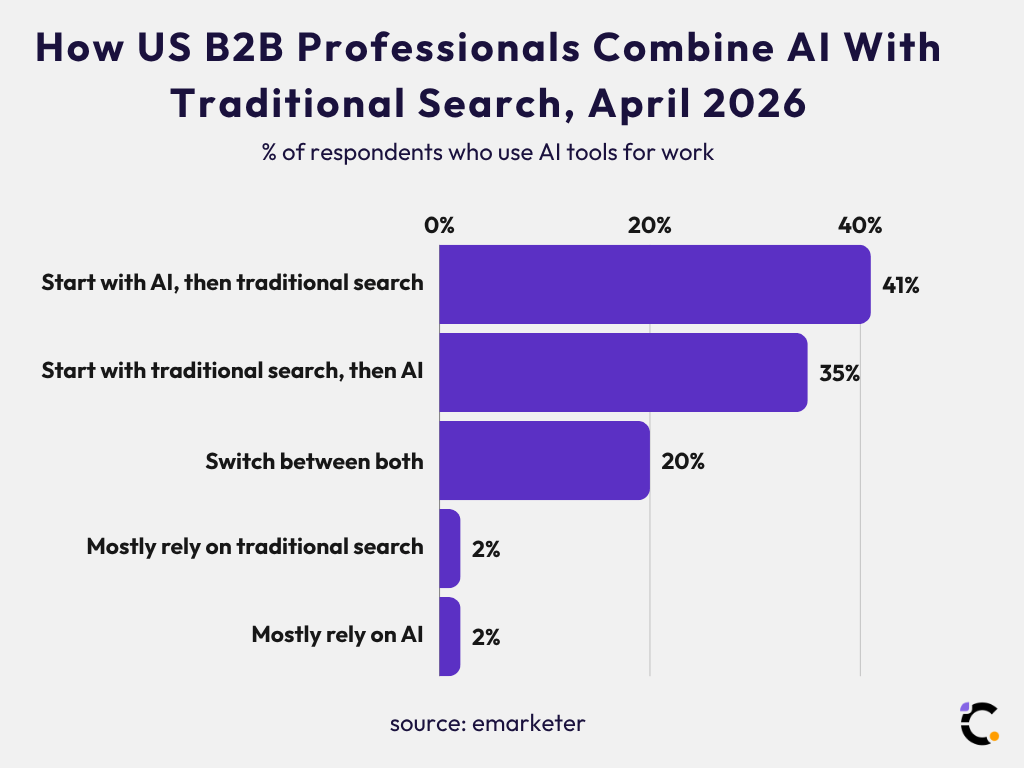
The rest of the data shows just how blended this behavior has become. Another 35% still start with traditional search and bring AI in afterward, while 20% say they switch back and forth between the two depending on the task. Only a combined 4% rely almost exclusively on one method, 2% sticking to traditional search alone and 2% relying mostly on AI. In other words, 96% of B2B buyers are now using AI and traditional search together in some sequence, not choosing one over the other. For any brand still measuring visibility purely through search rankings, this is a clear signal that the buyer’s path now runs through AI generated answers just as often as it runs through a results page.
One Fun Thing - Event Day Thursday!
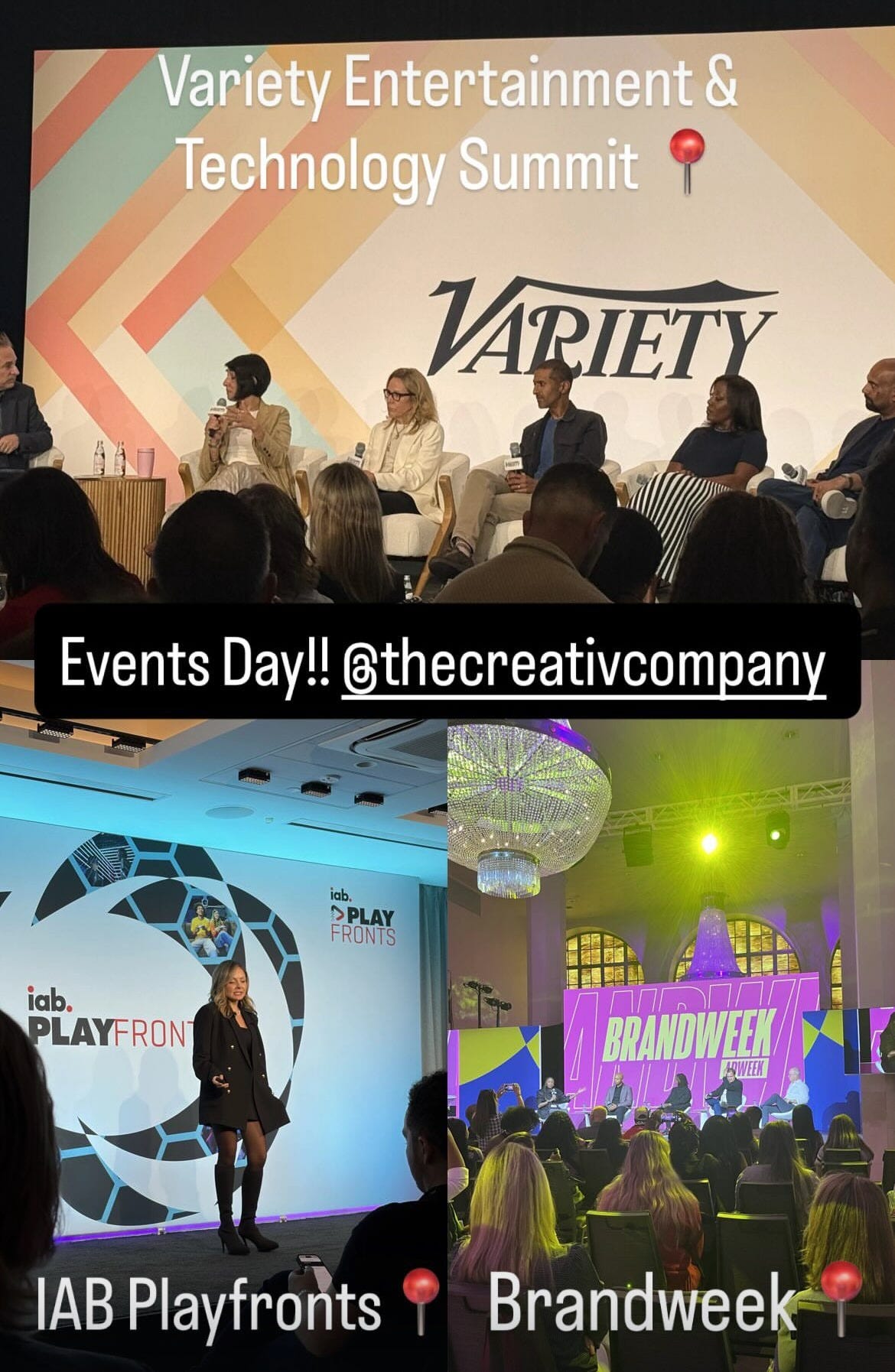
As we’ve grown, we can cover a lot more ground. Our team attended three different events yesterday to network with our peers in the media, advertising, and gaming space. Sarah Saul, our VP of Marcomms, attended Variety’s Entertainment & Technology Summit in LA. Kevin Villatoro, VP of Product & Strategy, scouted out the IAB Playfronts in NYC. I attended BRANDWEEK in Atlanta. Momentum baby!