



We’ve completed the initial build out of our leadership team at Creativ Company, and I have several learnings on how to find executive leaders.
Here’s the qualities we looked for in finding our leadership team.
Strategy and tactical: At a startup you need leaders with high level industry vision, knowledge and contacts to drive large enterprise value and then execute on it. Unfortunately, many senior leaders that move to startups have lost their “doer” mentality. They’ve come from large teams with dozens of direct reports that carried out the tactical execution. These people are delegaters. In startups you need both. Nothing gets done if you don’t do it yourself.
Optimistic and realistic: startups have low lows. Everyone in leadership must have an unreasonable optimism for the future possibilities of a business that doesn’t exist yet. Big breaks fall through, massive opportunities never materialize, fortunes go up and down daily. Leadership needs to be optimistic about the possibilities, but also grounded about the realities of business. Hope for the best and prepare for the worst.
Adaptable and accountable: things need to change on the dime. Leadership must constantly identify risks and opportunities as they arise in real time. Similar to point one, they must also be accountable to take on new challenges. The organizational structure must be fluid to allow new leaders to immediately take ownership of their department, but flexible enough to embrace new responsibilities on the fly.
I’ve spent five years growing and recruiting an executive leadership team worthy of growing a company with. We’ve had mishires and changes. The unlock was understanding the pool of candidates to recruit from: high potential executives from senior management ranks of larger media, entertainment, and advertising organizations that felt stuck, unmotivated, and under challenged.
These were the individuals that had the strategic knowledge base, forward outlook, and accountable framework to grow with us. Each one of our executive leaders has demonstrated that they possess all of the qualities above. Now it’s about scaling the right support team under them.
3 Stories Shaping Media, Gaming and Tech
Grand Theft Auto VI: An Extended Look drew 31.1 million Netflix views in its first four days, becoming the streamer’s most watched title globally for the week of August 24 through August 30, ranking number one in 87 of the 93 countries Netflix tracks — classified under the English-language film category despite being 27 minutes of in-game footage. The premiere, which Netflix held exclusively for six hours before Rockstar released it on YouTube, drove Netflix’s US mobile app usage up 35% in the hour it aired compared to the previous hour, and web traffic to Netflix climbed more than 125% against the 12-week Thursday baseline for that same time slot, according to Sensor Tower data reported by Forbes. The footage, captured entirely from PlayStation 5 hardware, showed protagonists Jason and Lucia across a range of Vice City missions and activities, and has since accumulated an additional 17 million views on Rockstar’s own YouTube channel on top of the Netflix numbers.
Why it matters: A 27-minute gameplay preview just outperformed every film and television series on the world’s largest streaming platform in the same week it aired. That is not a gaming milestone, it is a media industry milestone. Netflix did not need this content to sustain four weeks of viewing, they needed it to prove that a gaming event could move their platform the way a major film release does, and the Sensor Tower data confirms it worked beyond any reasonable projection. For brands and agencies planning around the GTA 6 November launch, the Netflix numbers are the clearest signal yet of the cultural scale this release is operating at, and the window to build something meaningful around that moment is getting shorter by the week.
Coyote vs Acme opened to $15.5 million domestically this past weekend, landing in second place behind Spider-Man Brand New Day and blowing past tracking that had the film projected at just $3 to $8 million as recently as three weeks ago, which is a result made more remarkable by the fact that Warner Bros. shelved the completed film as a tax write-off in November 2023, and it was rescued by independent distributor Ketchup Entertainment in 2025 for a reported $50 million. Starring Will Forte, Lana Condor, John Cena, and Tone Bell, the live-action and animation hybrid follows Wile E. Coyote suing ACME for decades of faulty products, and it earned a 96% critics score and 94% audience score on Rotten Tomatoes alongside an A CinemaScore from opening night audiences. The result marks the biggest opening in Ketchup Entertainment’s history by a significant margin, and analysts project a domestic run of $56 to $64 million based on its opening weekend trajectory and word of mouth.
Why it matters: Coyote vs Acme is a direct rebuke to every executive who approved shelving it. Warner Bros. decided the film was worth more as a tax deduction than as a theatrical release, and opening weekend proved that calculation wrong in the most public way possible. Beyond Hollywood politics, the story underneath the numbers is about audience trust and the power of grassroots advocacy. The film’s fanbase kept it alive through three years of uncertainty, and their word of mouth turned a $3 million tracking number into a $15 million opening. For brands and agencies, that fan mobilization story is worth studying. The audience did not wait to be told this film was worth seeing. They decided, organized, and showed up, so the box office followed.
WPP, the world’s largest advertising holding company, has eliminated roughly 9,000 jobs since the start of 2025 and is preparing to cut hundreds more by year end — all while reporting a 5.6% year-over-year revenue decline in the first half of 2026 as CEO Cindy Rose accelerates her Elevate28 restructuring program and openly names AI as the force reshaping how the company operates and how many people it needs to do so. Rose confirmed that some jobs will be impacted in the second half of the year while declining to specify exact numbers, framing the cuts not purely as cost savings but as a move to make WPP more agile and simpler to navigate under its new four-unit structure of WPP Media, WPP Creative, WPP Production, and WPP Enterprise Solutions. The company has already dropped from approximately 106,000 employees in the first half of 2025 to 97,000 in the same period this year, while completing more than 15 non-core asset disposals generating over £200 million in proceeds, and touting its AI platform WPP Open as the connective tissue binding the restructured business together across 5 billion consumers in over 100 markets.
Why it matters: WPP is not a struggling agency cutting costs to survive, it is the largest holding company in the world restructuring because the economics of creative production have fundamentally shifted. When a company of that scale attributes its operational overhaul directly to AI rather than to market conditions or client losses, it is sending a signal to the entire industry about where the pressure is coming from and where it is headed. The WPP restructuring is both a warning and an opportunity, the clients those holding company teams used to serve are going to need partners who can deliver the strategic direction and brand intelligence that AI cannot replicate, and agencies that have been building that positioning now have a larger audience looking for exactly that alternative.
Stat of the Week: The Highest Converting Traffic the Internet Has Ever Produced
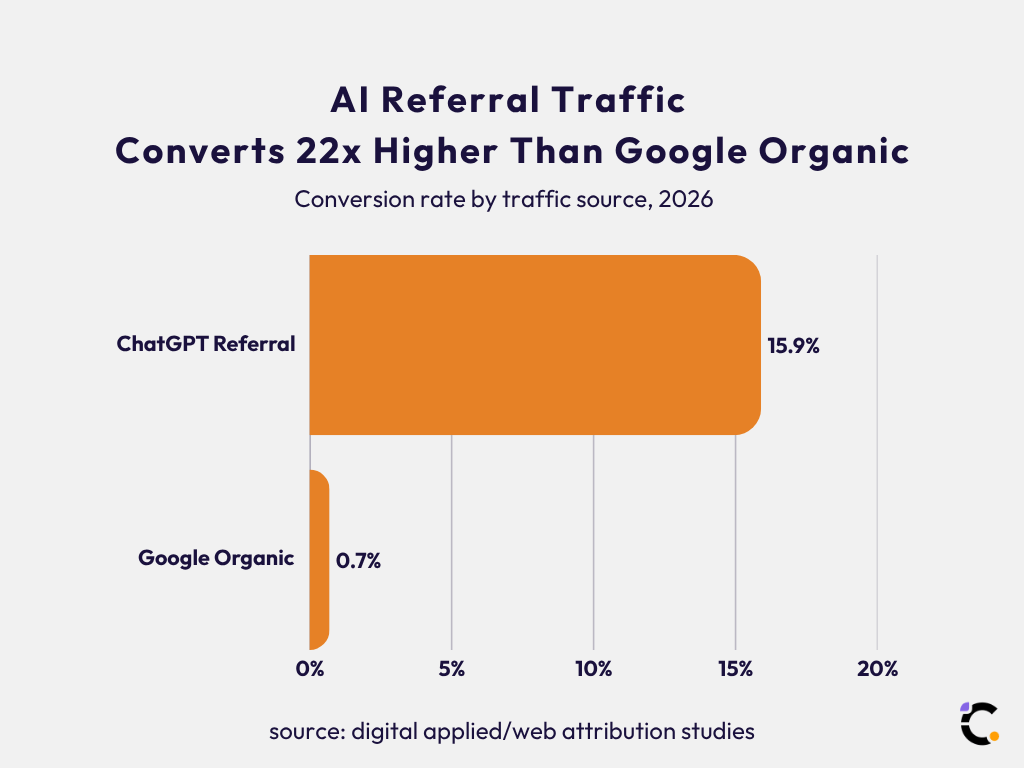
According to 2026 web attribution data compiled by Digital Applied and corroborated across multiple analytics platforms, traffic arriving from a ChatGPT referral converts at 15.9%. This is compared to just 0.7% for traditional Google organic clicks. That is not a marginal difference. It is a 22x gap between two traffic sources that most marketing teams are currently treating as roughly equivalent in their planning.
The reason is intent, and the reason intent is different is the conversation that happened before the click. A user who arrives at your site after a multi-turn AI conversation has already been told what you do, why you are relevant to their question, and how you compare to alternatives. They are not discovering, they are verifying. The click at the end of that journey is the last step of a qualification process the AI already ran on their behalf. For brands and agencies, this data fundamentally changes the conversation around what discoverability actually means in 2026. SEO built for Google optimizes for the moment someone types a query. Optimization for AI referral traffic requires being the named, trusted answer inside a conversation that may never produce a traditional search result at all. The brands building for that second scenario right now are not just ahead of the curve, but they are the only ones currently capturing the most valuable traffic on the internet.
One Fun Thing - Creativ Company at the US Open
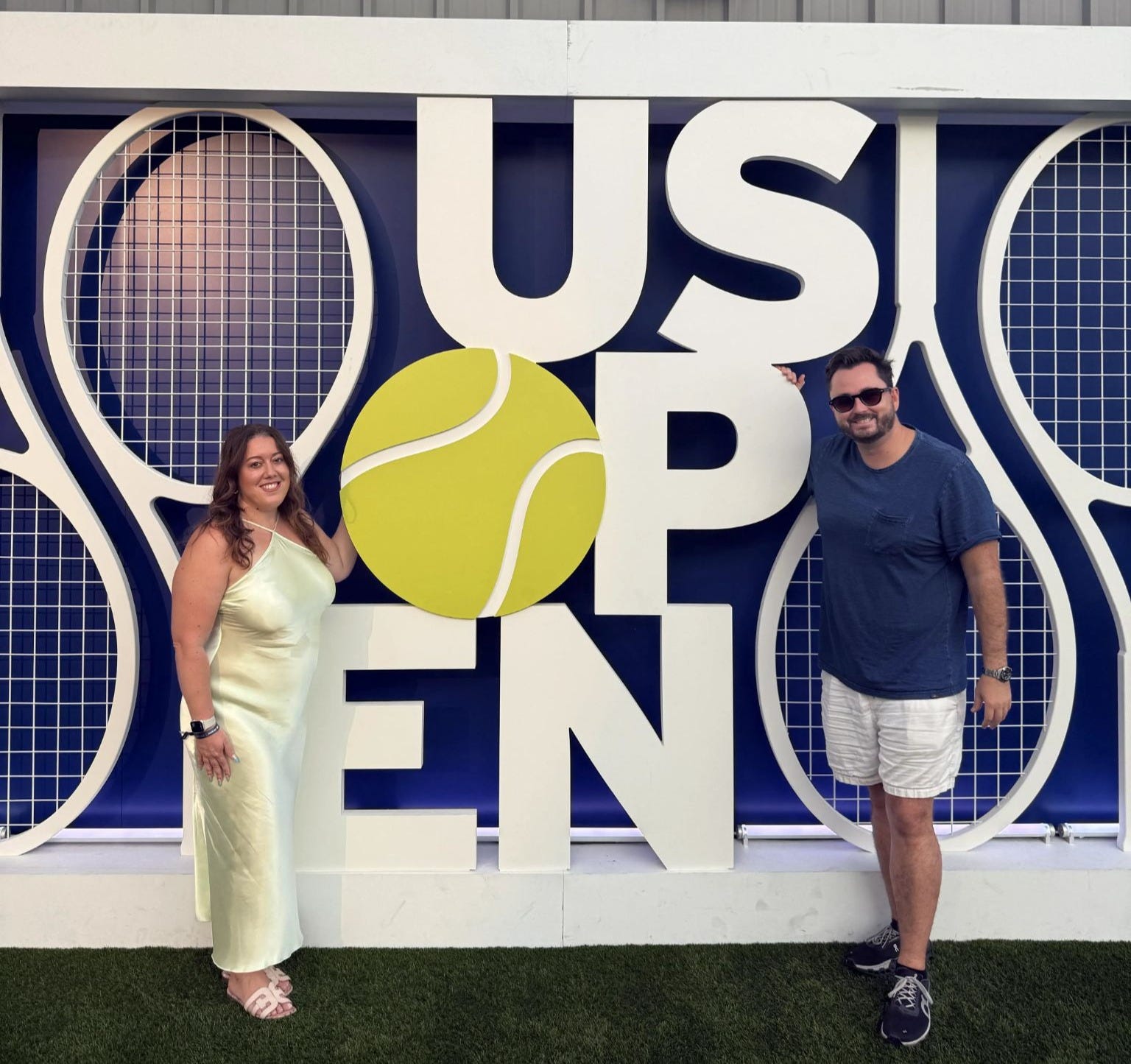
We spent last night at the US Open in NYC, treating clients and new friends to a few tennis matches! Honey Dueces and conversation were flowing.