



Summer’s done. People are coming back to their desks. We’ve built an elite team of marketing-technologists specialized for the media, entertainment, and advertising industry.
It’s time to sell.
But there’s a few hurdles we faced before building out a sales organization. Here’s three challenges and their solutions we’ve worked through over the last four weeks.
Finding great sales professionals is hard. For small firms bootstrapping like ours, the sales is an operational cost to the business until they generate revenue. So we created a hiring criteria for new sales representatives. They had to possess experience selling marketing-technology services, have a deep rolodex of media, entertainment, and advertising connections, and demonstrated ability to close six figure enterprise contracts. Everyone else is a no.
Building a firm is messy. We’ve experimented with lots and lots of different service offerings, which scattered our core value proposition and supporting collateral. We’ve spent the last month cutting down to our best performing services and building a corresponding messaging hierarchy to position us in the market.
Everyone needs to sing in unison. The larger the organization, the more intricate an internal communication strategy one needs to have everyone sing the same song. To do so we needed standardization of collateral, material, and messaging. Taking our newly unified messaging, we reworked our capabilities decks, produced collateral one-sheets, and distributed sales playbooks to all our contractors. Don’t send your sales ambassadors into battle unarmed. They need knowledge, ammo, and direction.
We’re launching our sales campaign Tuesday, September 15th. It’s been a busy four weeks getting the pieces in place, and we’re excited to see what happens when we put them to work.
Now comes the fun part. See you out there!
3 Stories Shaping Media, Gaming and Tech
Amazon announced a partnership with OpenAI on September 10th allowing brands on its advertsing platform to place ads directly inside ChatGPT through Amazon DSP, opening one of the fastest growing advertising surfaces in the industry to one of the largest retail advertiser bases in the world for the first time, with a pilot currently underway among select US brands including Delta Vacations. Amazon DSP powers the buying and campaign management layer while OpenAI’s own ad system controls all delivery decisions and placement, with ad units appearing as text or images beneath ChatGPT responses. Amazon described conversational ad formats of the kind found inside AI chatbots as the “fastest growing engagement opportunity” for brands to reach new and existing audiences, a statement that carries particular weight given Amazon itself ranked as the leading retail advertiser on ChatGPT from April through August before opening access to its broader advertiser base today. The deal adds ChatGPT to a long list of premium supply Amazon has locked down over the past 18 months alongside Netflix, Roku, Spotify, SiriusXM, Disney, Hulu, and ESPN.
Why it matters: ChatGPT reaches more than 900 million weekly active users and its ad business has already crossed $1 billion in annualized revenue run rate in under 200 days, but what Amazon brings to this partnership is not just scale, it is intent data. Brands using Amazon DSP can now combine Amazon’s first-party shopping signals with ChatGPT’s conversational context, reaching consumers at the exact moment they are describing what they want to buy and to whom. For agencies and brands building media plans in 2026, the Amazon and ChatGPT integration is the clearest signal yet that conversational AI advertising has moved from pilot curiosity to a legitimate line item in any serious media strategy.
Lucasfilm and Disney announced yesterday that Star Wars: A New Hope will receive its first ever IMAX release in its 49-year history, re-releasing the original unaltered 1977 cut in select IMAX 70mm film locations beginning February 19th, 2027, followed by Star Wars: Starfighter with Ryan Gosling in IMAX 70mm on May 28th, 2027, exactly 50 years to the weekend after the original film first opened in theaters. The announcement arrives as IMAX 70mm has had its most commercially successful year in history, generating a record $78 million in global box office almost entirely on the back of Christopher Nolan’s The Odyssey, which has now run for 11 consecutive weeks in the format and become the highest-grossing IMAX release of all time with over $450 million globally. Disney’s decision to commit both of its 2027 Star Wars theatrical releases to that format is a tacit acknowledgment of something audiences already proved at the box office this summer: the premium experience the industry spent years trying to engineer through proprietary formats like Disney’s own Infinity Vision has been outperformed by film projected at scale, and no marketing-driven alternative has come close to matching it.
Why it matters: The Infinity Vision story is the real lesson underneath the Star Wars announcement. Disney invested significantly in positioning their proprietary premium format as the definitive cinematic experience, but the gap between a proprietary experience a brand controls and an authentic experience an audience actually wants is one of the oldest tensions in marketing. Audiences have shown exactly how much they are willing to spend on a genuinely premium format, IMAX 70mm, and it drove the sales of The Odyssey, Sinners, Project: Hail Mary, and Oppenheimer into record territories. It created a cultural event around seeing movies in this format and Disney clearly sees which way the wind is blowing, and they are not going to miss the opportunity.
Nvidia CEO Jensen Huang declared that the era of artificial general intelligence has arrived after OpenAI unveiled GPT-6 Astra on September 4th, posting on X that the model was trained on more than 100,000 Nvidia Grace Blackwell NVLink72 chips and that the four-year arc from ChatGPT to o1 to Astra marks the moment AGI crossed from ambition to reality, with 400,000 more GPUs coming online next. OpenAI began rolling out Astra to enterprise customers under its Daybreak Access program before expanding to ChatGPT Plus, Pro, Business and Enterprise users as well as through the OpenAI API and AWS, billing the model as its most capable to date with major improvements in computer use, coding, scientific research, and professional work. Astra can carry out tasks like filling out online forms, updating customer records, organizing calendars, and conducting research autonomously, and OpenAI CEO Sam Altman said one of the capabilities that impressed him most was the model’s ability to identify problems users had not thought to ask about, going beyond the task as given to flag issues in adjacent areas the user had not considered.
Why it matters: The word AGI carries more weight than almost any other term in the technology industry, and the CEO of the company supplying the chips that power the entire AI ecosystem just used it without qualification on social media rather than on an earnings stage. Nvidia defines AGI as a system able to pass professional certifications and standardized tests across a range of fields with scores in the top tier, while OpenAI defines it as highly autonomous systems that outperform humans at most economically valuable work, and OpenAI President Greg Brockman told reporters before the launch that it is not unreasonable to feel that we are now in the AGI era. For brands and agencies, the practical question is not philosophical, but it is whether the tools now available can handle professional-grade work autonomously, and OpenAI’s own description of what Astra does suggests the answer for a growing category of tasks is yes.
Stat of the Week — Gaming Has the Audience. Advertisers Haven’t Shown Up Yet.
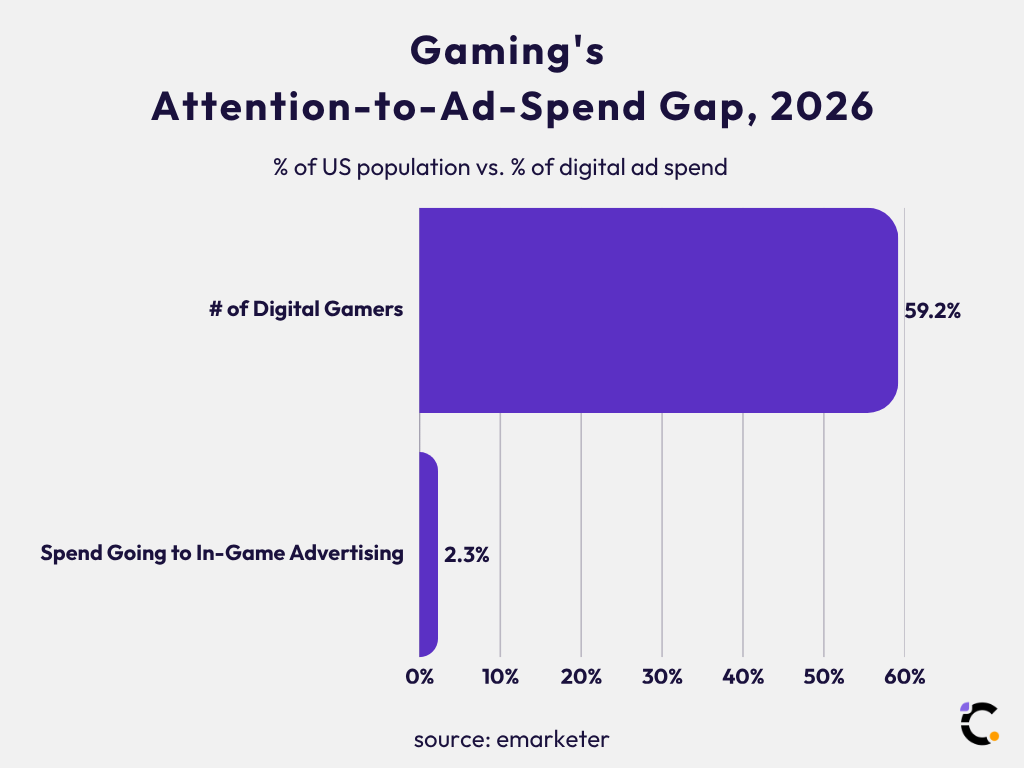
According to eMarketer’s 2026 gaming advertising forecast, 59.2% of the US population are active digital gamers this year — yet in-game advertising accounts for just 2.3% of total digital ad spending. That gap between where consumer attention lives and where advertising dollars actually flow is one of the largest mismatches in the entire digital media landscape, and it has been sitting in plain sight for years.
The disconnect becomes even harder to justify when you look at who is inside these games. Gaming reaches 76% of US adults aged 18 to 24, the most coveted demographic in advertising, and 65% of mobile gamers actively accept in-game ads rather than skipping or ignoring them. By comparison, 27% of gamers’ social media time and 25% of their streaming video time is already spent on gaming-related content — meaning the gaming audience is not a separate silo from the audiences brands are already chasing on Instagram and YouTube. They are the same people, spending more time in a place most advertising budgets have not followed them to yet. For brands and agencies, the math here is straightforward. The channel with the highest concentration of the audience you want, the highest receptivity to advertising, and the lowest competition for budget is gaming, and eMarketer projects in-game ad revenue will still only reach $10 billion in the US by 2029. The opportunity is not coming. It is already here and largely uncontested.
One Fun Thing - New Hire Ryan Tyrrell
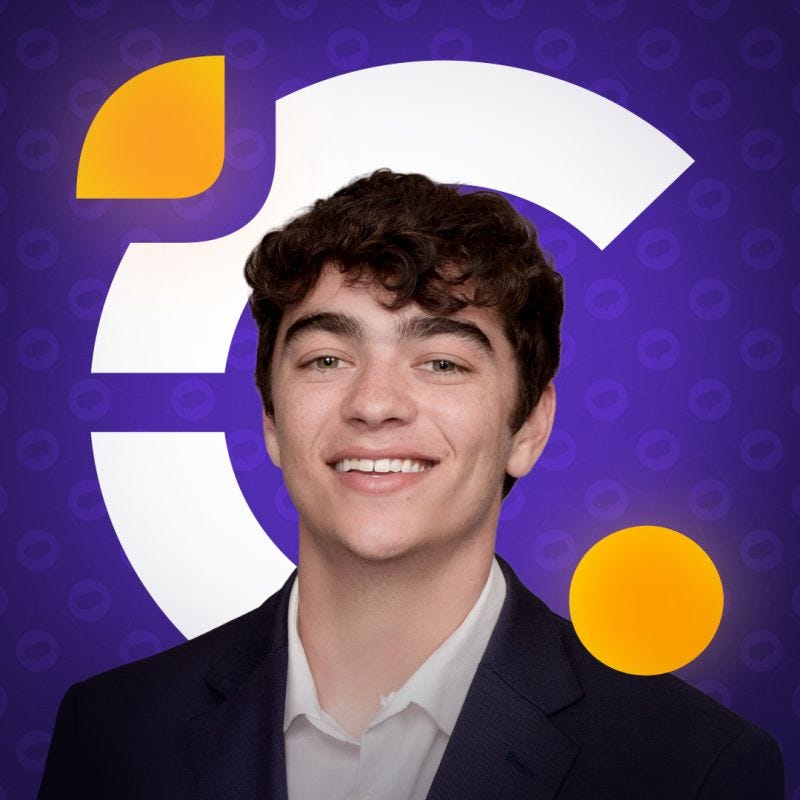
Please join us in welcoming Ryan Tyrrell as Creativ Company’s new Executive Operations Coordinator!
A recent graduate of Loyola Marymount University with a degree in Marketing, Ryan is ambitious, curious, and smart. At Fox Entertainment, he was the marketing strategy intern during the summer of his junior year. At KXLU, LA’s iconic college-based radio station, he helped run operations.
Ryan will report directly to the executive team, supporting the build out of our sales team, organizing executive itineraries, and developing new operational processes using an array of technologies.