



If you’re looking for dollars, nothing beats pounding the pavement.
When I was 16 years old, I needed money. I didn’t have any particular skills beyond being personable, so I figured waiting tables would be a good choice. Plus my older cousin told me it was lucrative.
So I printed out 30 resumes, laced up my vans, got in my 1984 stick-shift Mercedes, and drove to 30 different restaurants I enjoyed eating at and asked to see the manager.
I had a job by the end of the week, the newest waiter at Chili’s Bar & Grill at the Galleria Mall Houston. I worked there for the next 2 years.
This month alone, we’ll attend BRANDWEEK, Variety Entertainment & Tech Summit, Playfronts, AI Trail Blazers, Advertising Week NY, Runway AI Fest, AdWest Conference, Axios Media Trends, and the US Open. Plus, we hosted a NYC happy hour and a massive rooftop party at our new LA offices (see below).
Too many firms, employees, and entrepreneurs are passive. “Build it, and they will come,” are the immortal words of failed businessmen everywhere.
Hit the streets. Wear out your shoe leather. Hit the bricks. Beat the bushes. Put your nose to the grindstone. Hoof it. Leg it. Get out there!
Don’t wait for your customer to find you. They probably don’t even know they need you. Instead, go find your customer.
3 Stories Shaping Media, Gaming and Tech
Paramount Skydance settled an antitrust lawsuit brought by 12 state attorneys general on September 21st, clearing the way for its roughly $110 billion acquisition of Warner Bros. Discovery in exchange for a set of production and access commitments. Oregon Attorney General Dan Rayfield led the challenge, joined by California, New York, Washington and eight other states. Under the settlement, which still needs court approval, the combined company must spend at least $1.5 billion more on domestic production over five years than it did in 2025. It must also release 30 films a year in years one and two (20 of them wide releases), rising to 32 a year in years three through five, with at least four independent releases every year. Each missed film costs $30 million, paid to labor organizations, or Paramount can divest Miramax instead.
Why it matters: This is an unmitigated win for the Ellisons, and signals more consolidation in Hollywood. It puts Paramount+, HBO Max, CBS, CNN, TNT Sports, Warner Bros. and Paramount Pictures under one roof, which will change who brands and agencies negotiate with for upfronts, sports, news and premium streaming inventory. Regulators focused on output and jobs rather than streaming bundles or ad-market concentration, so the combined company is largely free to merge its ad sales and streaming platforms. The combined organization will hold more pricing power against both advertisers and consumers across film, news and live sports. The $30 million penalty for no movies is nominal, as most movies cost more than that to produce and market.
Microsoft reorganized its Xbox studios on September 22nd, handing development of the next mainline Halo game to a new dedicated team at Activision and moving several of its best-known studios under its biggest publishing labels. An internal memo from Xbox Chief Content Officer Matt Booty laid out the changes. Activision gets the next Halo “led by a new, purpose-built team that is separate from ongoing development and plans for Call of Duty.” It also takes over Rare (Sea of Thieves) and World’s Edge (Age of Empires). Bethesda takes over Obsidian Entertainment, which will keep working on Grounded and start a new Fallout project with Bethesda Game Studios. Playground Games and Turn 10 merge into one studio focused on Forza and Fable.
Why it matters: This is a strategy change, not a reshuffle. Microsoft is now using its $69 billion Activision Blizzard purchase to organize around a few big franchises under a few large publishing labels, instead of running a spread-out group of semi-independent studios. For brands, that should mean fewer, larger partnership conversations, with Activision now overseeing Call of Duty, Halo, Sea of Thieves and Age of Empires. The risk is creative concentration. Alongside PIF’s possible EA–Savvy merger, it’s another sign that the biggest owners in gaming are betting on scale and centralized franchise management, and partnership strategies should plan around that.
Shoppers can now buy retail products directly inside Google’s AI tools, including Google Search, the Gemini app and AI Mode, without ever visiting the company’s website, says Tapestry, the parent company of Coach and Kate Spade, which announced on September 24th that its brands are the latest to sign on. Tapestry joins Walmart and Ulta Beauty, which have already brought their products into Gemini and AI Mode. “Our goal is for shoppers to find and engage with our brands at the moment when inspiration strikes,” said Tapestry CEO Joanne Crevoiserat. Chief Information Officer Yang Lu said the company gets the same customer and transaction data from Google sales as it does from its own online store.
Why it matters: A major fashion brand treating an AI assistant as its own sales channel, alongside stores and its website, is a clear sign that “agentic commerce” is moving from pilot to real business. When shoppers can find and buy a product inside a chat, the brand’s website stops being the only place the sale happens. That changes where marketing dollars should go. The work of getting discovered shifts toward making sure product listings, images and descriptions are clean and complete enough for an AI to recommend them. Tapestry’s point about getting the same customer data matters too. Brands have long worried that selling through big platforms means losing the customer relationship, and data access will be the first thing every other brand asks about before signing on. For agencies, expect clients to start asking how to show up in AI shopping results, much as they asked about search rankings 20 years ago.
Stat of the Week — B2B pros trust AI to find answers more than to write them
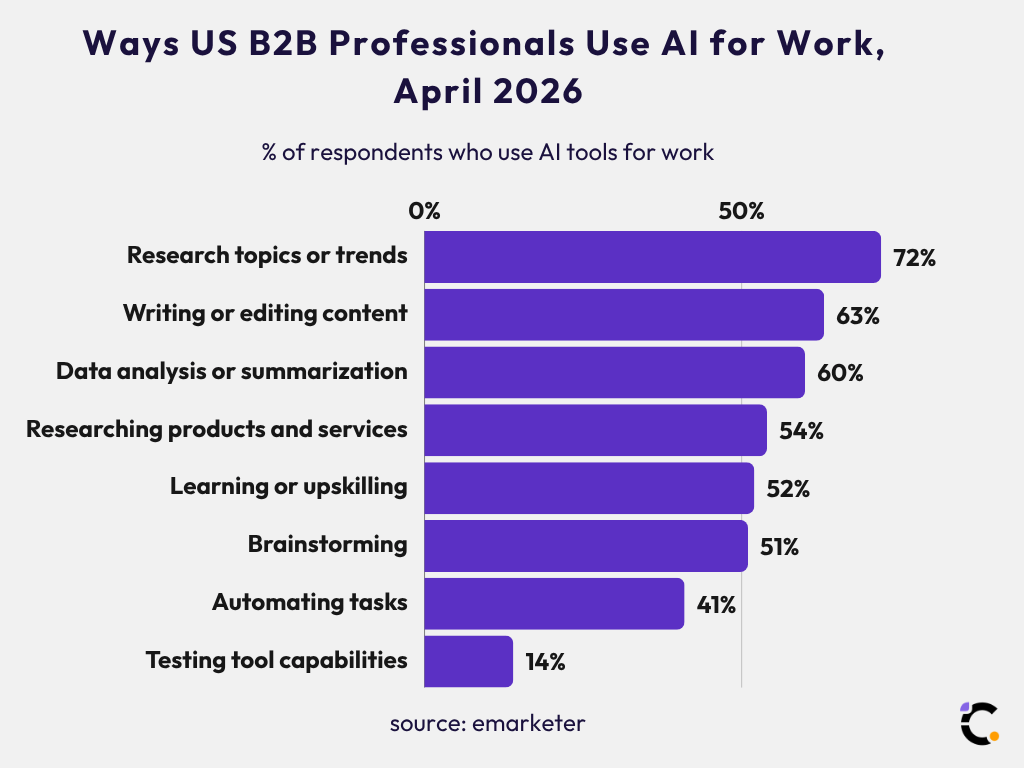
For US B2B professionals, AI’s biggest job at work is finding information, not creating it. According to a Semrush survey of B2B professionals who use AI at work, 72% use it to research topics or trends, ahead of writing or editing content (63%) and data analysis or summarization (60%). More than half also use AI to research products and services (54%), learn new skills (52%) and brainstorm (51%), while fewer use it to automate tasks (41%) or just test what the tools can do (14%).
For marketers, the takeaway is that AI is now a key part of how B2B buyers look for information, and a growing part of how they research vendors. With 54% already using AI to research products and services, brands need content that AI tools can easily find, understand and cite, not just content built to rank on Google. The very low share of people just testing the tools also shows that AI use at work has moved past experimenting and become a daily habit.
One Fun Thing - Opening Our Office with Adwest & AAF LA
Creativ Company hosted the official Welcome Reception & Mixer at our Santa Monica office and rooftop, bringing together marketers, creatives, and industry friends for great food, drinks, conversation, and one very LA sunset.
Huge shoutout to AAF Los Angeles, Wes Morton, Sarah Saul, Scott Kelly, Miles Mahoney, Ryan Tyrrell and everyone who came out to connect and celebrate.
A good reminder that even in an industry built around ideas, some of the best ones still start by simply showing up and talking face to face.